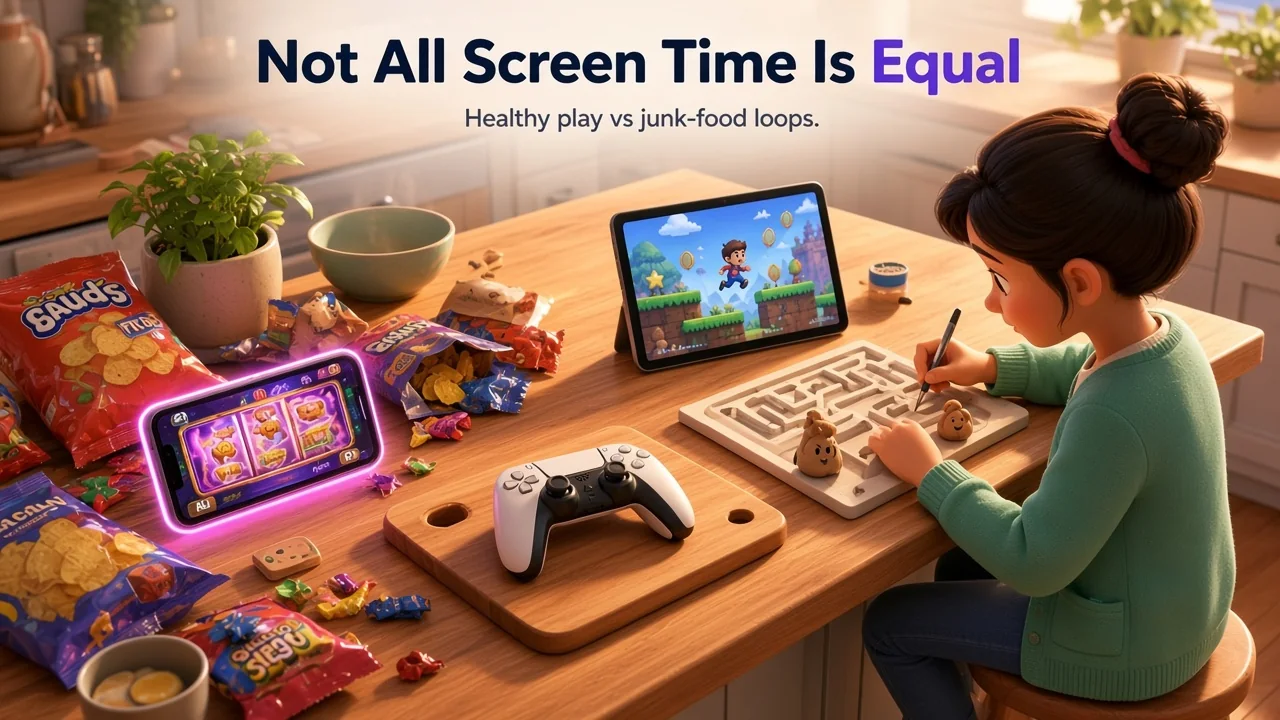
If you're a parent, you've probably had this experience: your kid is glued to a screen, and you can't quite tell if what they're doing is fine, or something you should worry about. "Video games" gets treated as one category, but that's a bit like treating "food" as one category. A homemade meal and a bag of chips are both food. They are not the same thing.
The same is true for games. Some games challenge kids, teach them things, and leave them feeling satisfied when they put the controller down. Others are built almost entirely to keep them playing — not because the game is good, but because it's engineered to be hard to stop. Learning to tell these apart is one of the most useful things a parent can do.
The "junk food" end of the spectrum
A huge number of games on Roblox and in mobile app stores fall into this category. They're not all bad — Roblox itself is just a platform, and some experiences on it are genuinely creative. But a large share of the most popular titles share a specific pattern:
- No real story, no characters worth remembering, no world to explore
- No meaningful challenge or skill curve — winning doesn't require getting better at anything
- Progress is driven by surprise rewards, spinning wheels, timers, or "just one more round" mechanics — the same tricks used in slot machines, where you win just often enough to keep pulling the lever
- Making money is built into the core of how the game works: ads between every round, in-game currency you're nudged to buy, items that make the free version feel deliberately worse so you'll pay to fix it
- The goal isn't fun, it's keeping you logged in — measured in how often you come back, not how good the game actually is
These games are designed by people who understand psychology very well, and they use the same tricks as a slot machine: rewards that arrive unpredictably (which makes them more addictive than a steady payout would), fake scarcity ("offer ends in 10 minutes!"), and social pressure to keep a daily streak alive so you feel like you'll lose something by stopping. Kids don't lack willpower when they struggle to put these down — the games are quite literally built by adults to be hard to stop playing. That's worth remembering the next time it turns into a fight at dinnertime.
The high-quality end: Zelda and games like it
At the other end, you have games like The Legend of Zelda. These take real skill to make and real skill to play. They have:
- A story with stakes, characters, and a world that rewards curiosity
- Genuine challenges — puzzles, combat, exploration — where getting better actually matters
- A satisfying arc: a beginning, a middle, and an end
- Depth that rewards attention instead of exploiting inattention
When a kid finishes a game like this, they usually feel a sense of accomplishment, not a vague itch to open it again for no clear reason. It's closer to finishing a good book or a well-built puzzle than it is to scrolling a feed.
The healthy middle: games like Mario Kart
Not every good game needs to be an epic. Plenty of games sit comfortably in the middle: genuinely fun, skill-based, social, and bounded — without leaning on dopamine-loop tricks to keep kids playing past the point of enjoying it. Mario Kart is a good example. So are most well-made local multiplayer games, sports games, and puzzle games. You play a round, it's fun, it ends, everyone moves on. There's competition and mastery involved, but no engineered compulsion loop underneath it.
The newer problem: mobile games built entirely on the loop
It's also worth calling out mobile gaming specifically, because it's gotten worse in the last several years. A huge share of free-to-play mobile games today are essentially ways to show you ads and sell you things, dressed up as a game — match-three puzzles, "idle" games that send notifications nagging you to come back, or games built around paying real money for a random chance at a rare character or item (a "gacha pull," named after Japanese toy vending machines — you don't know what you'll get until after you've paid). Almost none of this is really about play. It's about holding your attention and getting you to spend money, aimed at a brain — a kid's brain especially — that's still learning to resist that kind of pull.
Where Makerplay fits in
This is part of why I built Makerplay. Instead of just consuming games, kids aged 8-16 design and build their own browser-based games, guided by two AI coaches, Luna and Willy, who help them work through ideas rather than build it for them. A few things make it different from the junk-food end of the spectrum:
- No ads. None of the manipulative money-making tricks that show up in mobile "free" games.
- Kid-built game library. Kids can play games other kids made — real creative work, not content designed to maximize how long they stare at a screen.
- Remixing. Any game in the library can be remixed — kids can take something another kid built, understand how it works, and make it their own by improving or changing it.
- Making instead of consuming. The core activity is building, which involves planning, problem-solving, and iteration — the same skills a good challenging game teaches, but with the kid in the driver's seat instead of the loop.
The goal isn't to compete with Zelda — it's to give kids a way to spend screen time creating things, in a space explicitly built without the manipulative mechanics that define so much of the Roblox and mobile app landscape.
A simple way to evaluate any game your kid wants to play
Next time your kid asks for a new game, a few quick questions can tell you a lot:
- Does it end? Good games have a clear sense of progress or completion. Junk-loop games are designed to never really end.
- Does getting better matter? If skill is irrelevant to progress, that's a red flag.
- Is there a story or world, or just a loop? Depth vs. repetition is a good proxy for quality.
- How does it make money? Ads every few minutes and pressure to buy currency are signs the business model is attention, not enjoyment.
- How do they feel afterward? Satisfied and done, or itchy to open it again?
None of this means banning Roblox or mobile games outright — plenty of genuinely good experiences exist on both. But treating "screen time" as a single bucket misses the point. The real question isn't how long they played. It's what the game was built to do to them while they played it.